
As a clinical psychology doctoral student, I often find myself drawn to books that bridge the gap between psychological theory and everyday life. There’s something incredibly satisfying about watching complex concepts like desire, repression, and identity play out not just in the therapy room, but in the cultural and economic systems we live within. Capitalism and Desire: The Psychic Cost of Free Markets by Todd McGowan is one of those rare books that speaks to both the theorist and the citizen — a compelling psychoanalytic lens on capitalism’s seductive power.
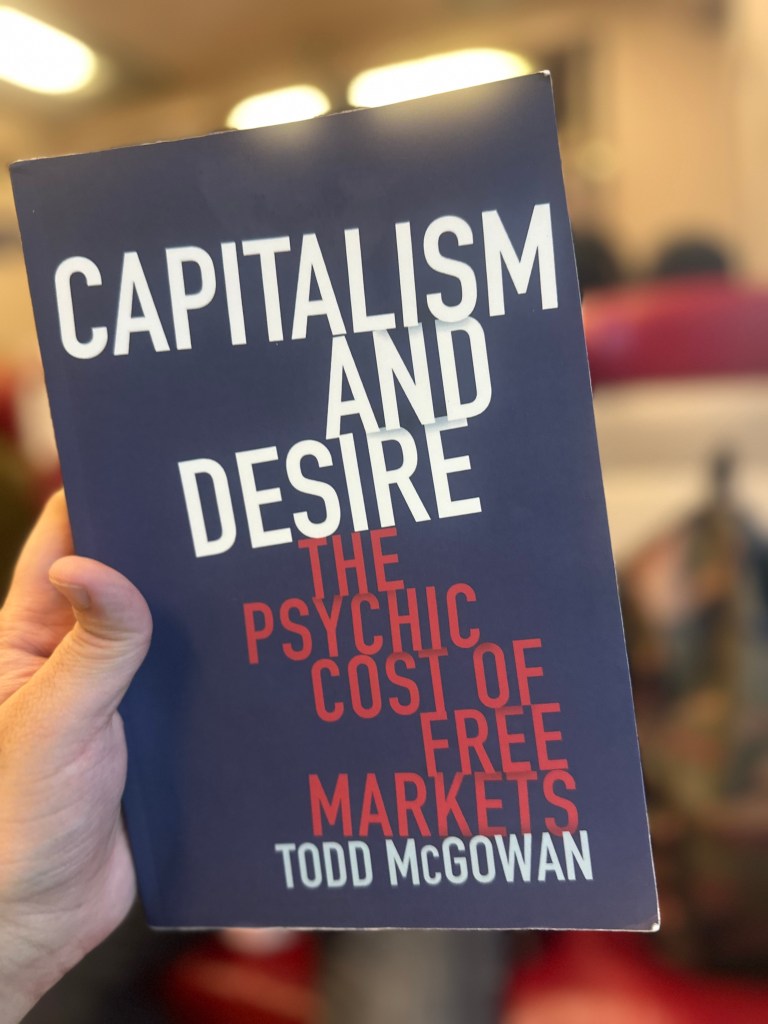
In this book, McGowan explores a fascinating idea: that capitalism doesn’t succeed because it fulfills our desires, but precisely because it keeps them alive. Drawing from Lacanian psychoanalysis, he argues that our economic system thrives on dissatisfaction — not as a bug, but as a feature. Capitalism, in this view, sustains our endless longing by promising fulfillment that never fully arrives.
Rather than condemning desire itself, McGowan encourages a deeper understanding of how desire operates. We’re not just consumers of products — we’re participants in a psychic loop that the market expertly manipulates. That new gadget, lifestyle, or aesthetic trend isn’t really about what it offers; it’s about keeping the fantasy alive. The result is a system where we are always chasing, never arriving — a dynamic that mirrors many of the struggles I see in clinical work: the frustration of never feeling “enough,” of reaching goals only to find new ones replacing them, of confusing wants with needs.
What I appreciated most was McGowan’s refusal to settle for cynicism. He doesn’t just critique capitalism from a distance; he challenges us to imagine what a world beyond the endless churn of consumer desire might look like — and what it would take, psychically, to get there.
For those considering picking this up, here’s a quick snapshot of my take on the book:
📚 Quick Review
Rating: ★★★★☆ (4.5/5)
What I loved:
- A fresh and rigorous application of Lacanian theory to capitalism — intellectually dense, but never dry.
- The book bridges abstract psychoanalytic ideas with tangible social phenomena in a way that’s rare and compelling.
- McGowan’s insights feel eerily relevant in a time of algorithmic consumerism and perpetual distraction.
What to know going in:
- This is not pop-psych — McGowan engages deeply with Freud, Lacan, and Marx, so some familiarity with those thinkers (or willingness to Google along the way) will help.
- The writing is thoughtful but assumes a reader ready to wrestle with theory.
Bottom line:
If you’re fascinated by the inner mechanics of capitalism — not just what it does to our wallets, but what it does to our wants — Capitalism and Desire is a must-read. It challenges how we think about satisfaction, freedom, and the very structure of desire itself.
Capitalism and Desire doesn’t offer easy answers, but it offers the kind of deep, conceptual clarity that lingers long after the last page. As someone invested in both the clinical and cultural dimensions of psychology, I found it both challenging and energizing — a reminder that understanding the world we live in starts with understanding how we desire within it.


 TheIndianBookworm
Leave a comment